
Your 40s and 50s can be a time when you feel more confident and comfortable in your own skin than ever before. However, you may also begin noticing changes in your appearance that weren’t particularly noticeable a few years earlier. Fine lines may become more defined, your cheeks might look slightly less full, or your skin may not have quite the same smoothness and firmness it once did.
These changes are a normal part of aging, influenced by genetics, sun exposure, hormonal changes, and the gradual decline of collagen and elastin. Although some changes begin much earlier, they often become more noticeable during these decades. Modern aesthetic medicine offers several ways to address these concerns while preserving the features and expressions that make your face unique.
At WINK Aesthetics + Wellness, we believe facial rejuvenation should begin with understanding your individual concerns, rather than choosing a treatment based on age alone.
How Does Your Face Change in Your 40s and 50s?
Facial aging involves more than the development of wrinkles. Several changes take place beneath the skin’s surface, affecting its structure, appearance, and ability to maintain moisture.
- Collagen and elastin decline: Skin gradually loses some of its firmness and resilience.
- Facial volume changes: Shifts in fat distribution, bone structure, and soft tissue support can affect the cheeks and jawline.
- Skin renewal slows: Changes in cell turnover can contribute to a duller complexion and rougher texture.
- Sun damage becomes more visible: Years of UV exposure can contribute to pigmentation, fine lines, and uneven skin tone.
These changes don’t happen at the same rate for everyone. Someone in their early 40s may experience noticeable volume loss, while another person in their late 50s may be more concerned about fine lines or uneven skin tone. Understanding these differences helps determine which aspects of facial aging may benefit from professional treatment.
What Are the First Signs of Facial Aging in Your 40s?
For many people, their 40s bring subtle changes rather than dramatic differences. You may still have relatively firm skin and good facial volume, but begin noticing that your complexion needs a little more attention to maintain its usual appearance.
Expression Lines May Become More Noticeable
Repeated facial movements gradually contribute to lines across the forehead, between the eyebrows, and around the eyes. Initially, these wrinkles may appear only when smiling, frowning, or raising your eyebrows. Over time, some can become visible even when your face is at rest. For patients who would like to soften these lines, Botox® and other neuromodulators can temporarily reduce the muscle activity responsible for their formation.
Options such as Dysport®, Xeomin®, Daxxify®, and Letybo® allow treatment to be individualized according to facial anatomy, muscle movement, and aesthetic goals. The objective isn’t necessarily to eliminate every line. Many patients prefer to maintain natural facial expressions while reducing wrinkles that make them look tired or tense.
Treatment placement, dosage, and individual muscle activity all influence the outcome, making a personalized assessment more important than choosing a product based on brand recognition.
Skin Texture and Radiance Can Begin to Change
Another common concern in your 40s is that your skin may no longer look as smooth or radiant as it once did. Changes in cell turnover, hydration, and accumulated environmental damage can make the complexion appear duller. Makeup may settle into fine lines more easily, and uneven texture can become increasingly noticeable.
For milder concerns, improving skin health may be a more appropriate starting point than intensive rejuvenation. Treatments such as Hydrafacial® and Bela MD+ combine professional cleansing, exfoliation, and hydration-focused care to help improve the appearance of dull, congested, or dehydrated skin.
While these treatments cannot replace lost facial volume or correct significant laxity, they can play a useful role in maintaining a smoother, healthier-looking complexion.
Why Does Facial Aging Become More Noticeable in Your 50s?
During your 50s, changes that developed gradually over previous decades may become more apparent. Several biological processes influence the skin and underlying facial structure, although their effects vary considerably between individuals.
For women, menopause can be particularly significant. Declining estrogen levels affect collagen, skin thickness, hydration, and elasticity, potentially making the skin feel drier, thinner, or less resilient.
Hormonal changes are only part of the picture. Genetics, lifestyle, cumulative sun exposure, and changes in facial volume also contribute to how the face ages. The relationship between hormones and changing skin quality helps explain why concerns such as dryness, uneven texture, and reduced firmness may become more noticeable at different stages of adulthood.
Changes in Cheek Volume and Facial Definition
One of the more noticeable differences during this decade can be a gradual reduction or redistribution of facial volume. The cheeks may appear flatter, the transition between the lower eyelids and cheeks can become more pronounced, and the jawline may lose some of its previous definition. These changes can sometimes create a tired appearance, even when you’re feeling well-rested.
When volume loss is a significant concern, carefully placed dermal fillers may help restore support and improve facial contours. Hyaluronic acid fillers provide volume in selected areas, while collagen-stimulating options such as Sculptra® work more gradually by encouraging the body’s own collagen production.
The distinction matters because not every change in facial definition is caused by volume loss. Skin laxity and the downward movement of facial tissues can also affect contours, and adding filler may not be the most appropriate solution.
Skin May Feel Thinner, Drier, or Less Firm
As collagen production declines and the skin’s ability to retain moisture changes, fine lines may become more apparent, particularly around the eyes, mouth, and cheeks. For some patients, improving hydration and maintaining a consistent skincare routine can make a meaningful difference to how their skin feels and looks.
Others may benefit from treatments that address more established textural changes. Dryness, wrinkles, and laxity are not interchangeable concerns, and understanding their different causes helps avoid unnecessary procedures and supports more appropriate treatment decisions.
Which Aesthetic Treatments Make the Biggest Difference in Your 40s and 50s?
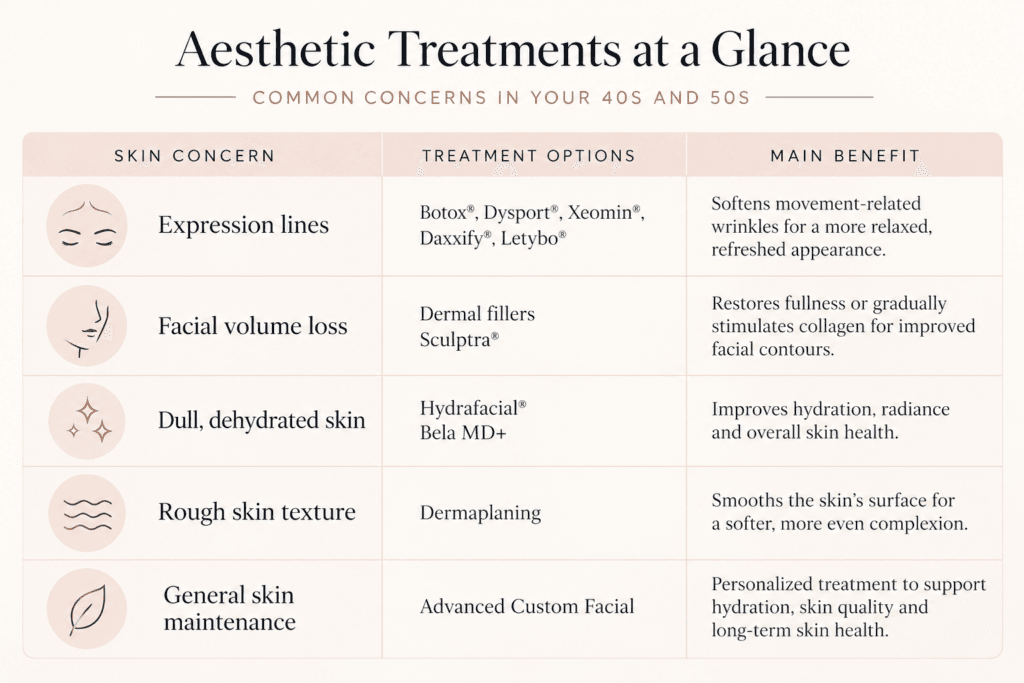
The most effective approach is one that addresses your main concerns without unnecessarily changing your natural features. Rather than choosing a treatment based on age, it can be helpful to consider what you would most like to improve:
- Expression lines: Neuromodulators may help soften wrinkles caused by repeated facial movement.
- Facial volume loss: Dermal fillers or collagen-stimulating injectables may help restore selected areas of lost fullness.
- Dullness and dehydration: Professional facial treatments can support hydration and improve the appearance of tired-looking skin.
- Rough or uneven texture: Dermaplaning and suitable exfoliating treatments may help create a smoother-looking complexion.
- Multiple aging concerns: A staged treatment plan may be appropriate when several changes need addressing. This staged approach may include the use of more advanced technologies like microneedling with radiofrequency, laser treatments, or non-surgical ways to lift the skin through energy-based devices.
A personalized advanced custom facial may also support hydration and ongoing skin maintenance, particularly for patients whose main concerns are related to skin quality rather than facial volume or deeper structural changes.
A patient in their 40s with mild skin changes may achieve their goals through skincare and occasional maintenance treatments. Someone in their 50s with several overlapping concerns might benefit from a staged approach, allowing time to assess the response before considering additional procedures.
The aim is not to treat every visible sign of aging, but to identify where treatment can make a meaningful difference.
What Should You Consider Before Choosing an Aesthetic Treatment?
Before deciding on treatment, it helps to identify what you would most like to improve. However, suitability involves more than the appearance of your skin. Several factors should be considered:
- Your main concern: Whether you want to address wrinkles, volume loss, skin texture, or general maintenance.
- Medical history: Existing conditions, medications, allergies, and previous aesthetic procedures may affect suitability.
- Recovery time: Some procedures involve temporary redness, swelling, bruising, or downtime.
- Expected results: Improvements may be immediate or develop gradually, depending on the treatment.
- Long-term maintenance: Some procedures require repeat appointments to maintain their effects.
For patients who prefer gradual changes, treatment can often be approached in stages. This allows the clinician to assess progress, adjust recommendations, and avoid unnecessary intervention. The most appropriate plan should reflect your concerns, lifestyle, and preferences rather than following a standard treatment schedule based on age.
Frequently Asked Questions About Aesthetic Treatments in Your 40s and 50s
How Long Do Aesthetic Treatment Results Usually Last?
Longevity varies according to the procedure, product, treatment area, and individual response. Neuromodulator results often last approximately three to four months, although some formulations may last longer. Hyaluronic acid fillers can last several months to over a year, depending on the product and placement. Facial treatments generally require more regular maintenance.
Can You Have Aesthetic Treatments if You Have Sensitive Skin?
Potentially, although suitability depends on the cause and severity of your sensitivity. Patients with conditions such as rosacea, eczema, or an impaired skin barrier may need a modified approach. An assessment can help determine whether treatment is appropriate or whether the skin should be stabilized first.
Can You Combine Injectable Treatments With Professional Facials?
Yes, selected treatments can be incorporated into the same overall rejuvenation plan, but they may need to be scheduled separately. Appropriate spacing depends on the procedures involved, the condition of your skin, and your clinician’s recommendations.
Do You Need to Stop Using Retinol Before an Aesthetic Treatment?
Some procedures require a temporary adjustment to active skincare ingredients, including retinoids and exfoliating acids. The timing depends on the treatment and your skin’s sensitivity, so follow the specific pre-treatment and aftercare instructions provided by your clinician.
A Personalized Approach to Facial Aging at WINK Aesthetics + Wellness by Atlantic Eye
Your 40s and 50s can be an excellent time to take a more considered approach to skin health and facial rejuvenation. Whether your priority is softening expression lines, addressing volume loss, or maintaining a healthy complexion, the goal should be to preserve your natural features while making improvements that feel right for you.
At WINK Aesthetics + Wellness by Atlantic Eye, our physician-led team provides personalized assessments for patients across Monmouth County and northern Ocean County, NJ, considering facial anatomy, skin health, and individual goals before recommending treatment. Schedule a consultation to discuss your concerns and explore which options may be appropriate for your skin and stage of life.