
When it comes to facial rejuvenation, many people simply want to look refreshed while still looking like themselves. Perhaps you’ve noticed that expression lines are becoming more visible, your cheeks aren’t quite as full as they once were, or your facial contours have gradually changed. The good news is that there are several injectable treatments that can help, depending on what you would like to improve.
Botox®, dermal fillers, and Sculptra® are three popular options, each offering a different approach to facial rejuvenation. Botox helps soften expression lines by temporarily reducing activity in selected facial muscles, dermal fillers restore volume and definition, and Sculptra gradually encourages your body’s natural collagen production. Understanding these differences can make choosing a treatment much easier, particularly when natural-looking results are your priority.
At WINK Aesthetics + Wellness, we consider your facial anatomy, skin quality, and personal goals to help identify the treatments that will best complement your features.
What Is the Difference Between Botox, Dermal Fillers, and Sculptra?
Although all three treatments can help create a refreshed appearance, they work in different ways and are suited to different concerns.
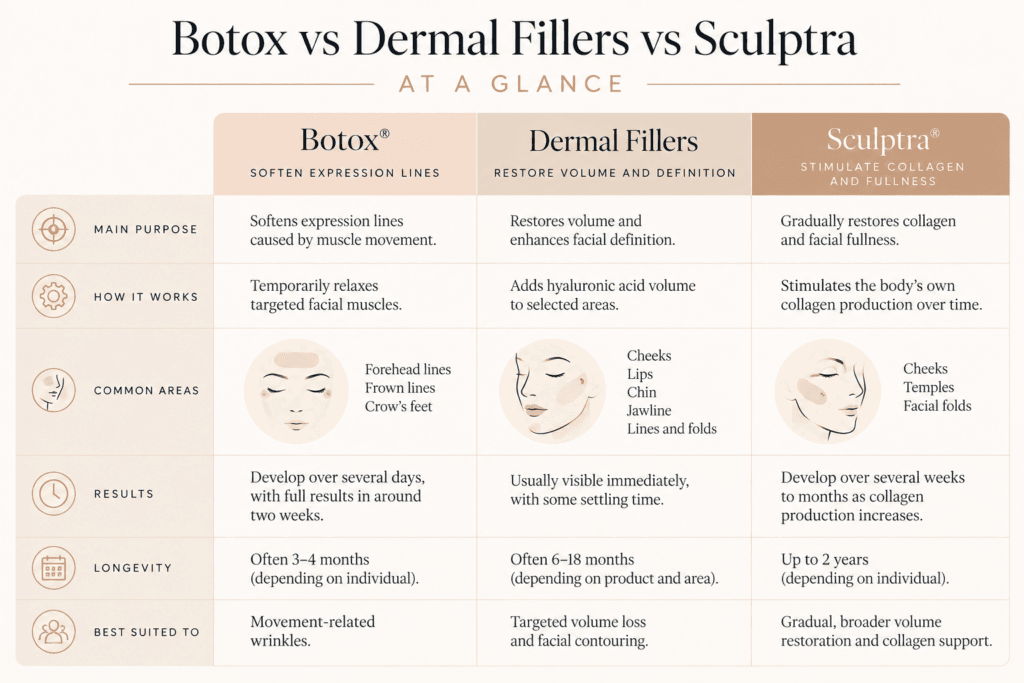
- Botox: Softens expression lines, including frown lines and crow’s feet, by temporarily reducing activity in selected facial muscles.
- Dermal fillers: Restore or enhance volume in specific areas, helping improve facial fullness and definition.
- Sculptra: Encourages collagen production over time, gradually improving facial volume and structural support.
These differences are useful to understand because facial aging doesn’t affect everyone in the same way. Fine lines that appear when you smile, for example, have a different cause from reduced cheek volume or changes in facial firmness. It’s also common to notice more than one concern as your skin and facial structure change over time. Depending on your goals, a single treatment may be enough, or a carefully planned combination may offer a more balanced approach.
How Does Botox Work for Facial Rejuvenation?
Botox is a neuromodulator that temporarily reduces activity in targeted facial muscles responsible for expressions such as smiling, frowning, and raising your eyebrows. These movements are a natural part of everyday life, but over time, repeated muscle activity can contribute to lines that remain visible even when your face is relaxed. Botox helps soften these movement-related wrinkles, creating a smoother, more refreshed appearance. With careful treatment planning, you can still enjoy natural facial expressions while reducing the appearance of lines that have become more noticeable.
What Areas Can Botox Treat?
Common treatment areas include:
- Forehead lines: Softens horizontal wrinkles associated with raising your eyebrows.
- Frown lines: Reduces the appearance of vertical lines between the eyebrows.
- Crow’s feet: Smooths fine lines around the outer corners of the eyes.
Results usually begin to develop within several days, with the full effect becoming noticeable in approximately two weeks. Improvements commonly last around three to four months, although this varies from person to person.
Is Botox the Only Neuromodulator Available?
Botox is one of several neuromodulators used in aesthetic medicine. We also offer Dysport®, Xeomin®, Daxxify®, and Letybo®, providing different options to suit individual treatment needs.
Although these products work in similar ways, they differ in formulation, dosing, and individual response. Some patients may have preferences based on previous treatments, while others may be interested in options associated with potentially longer-lasting results. Rather than choosing a neuromodulator based on its name alone, we consider your facial movements, treatment history, and the results you would like to achieve. This helps us recommend an approach that suits your features and maintains a natural-looking appearance.
How Do Dermal Fillers Restore Facial Volume?
While Botox focuses on expression lines, dermal fillers are designed to restore or enhance volume in selected areas of the face. As we get older, changes in facial fat, bone structure, and soft tissue support can gradually influence our appearance. You may notice that your cheeks look less full, lines around your mouth become more defined, or your jawline loses some of its previous definition.
Hyaluronic acid fillers offer a way to address certain changes by adding volume and providing support where it is needed. Treatment can be tailored to enhance your natural facial proportions while maintaining a soft, balanced appearance.
What Areas Can Dermal Fillers Improve?
Depending on your facial anatomy and treatment goals, fillers may be used to improve:
- Cheeks: Restore fullness and enhance facial contours.
- Lips: Add volume or improve shape and definition.
- Chin and jawline: Create greater definition and facial balance.
- Lines and folds: Soften certain creases associated with changes in facial volume.
One of the benefits of hyaluronic acid fillers is that results are generally visible immediately, although some initial swelling and settling are expected. Depending on the product, treatment area, and individual response, results often last approximately six to eighteen months.
Will Dermal Fillers Make Your Face Look Different?
Dermal fillers don’t have to dramatically change your appearance. When carefully selected and placed, they can help restore subtle fullness and improve facial proportions while preserving the features that make you look like yourself. For example, someone with mild cheek volume loss may benefit from a small amount of filler to restore support and definition. However, if loose skin is the main concern, a different approach may be more suitable.
The key is understanding what is contributing to the change in your appearance and choosing treatment accordingly. This allows us to focus on enhancing your existing features rather than simply adding volume.
How Is Sculptra Different From Traditional Dermal Fillers?
Sculptra is an injectable collagen stimulator made from poly-L-lactic acid (PLLA). Unlike hyaluronic acid fillers, which provide volume directly, Sculptra works by encouraging your body to gradually produce new collagen.
Collagen plays an important role in maintaining facial structure, firmness, and fullness. As natural collagen production declines with age, areas such as the cheeks may begin to look less full. Sculptra can help address these changes by encouraging gradual collagen production, making it an appealing option for patients who prefer progressive improvements, particularly when facial volume loss affects broader areas.
What Facial Concerns Can Sculptra Improve?
Depending on individual suitability, treatment areas, and product indications, Sculptra may help with:
- Hollow or flattened cheeks: Gradually improve facial fullness.
- Facial volume loss: Support a gradual improvement in contours where fullness has decreased.
- Smile lines and facial folds: Soften their appearance when volume loss is a contributing factor.
- Gradual collagen decline: Encourage collagen production to improve facial support over time.
Sculptra results develop progressively as new collagen forms. Most patients require a series of treatments, with improvements becoming more noticeable over several weeks to months. Results may last up to two years, although individual experiences vary.
Does Sculptra Look More Natural Than Dermal Fillers?
Both Sculptra and dermal fillers can produce natural-looking results when used appropriately. The main difference is how those improvements develop. Sculptra is often appealing to patients who prefer gradual changes and want to address more widespread volume loss, while dermal fillers may be better suited to someone looking for more immediate fullness or precise facial contouring.
Neither approach is automatically more natural than the other. What matters most is choosing the right treatment for your facial anatomy, concerns, and desired outcome.
What Should You Know Before Choosing an Injectable Treatment?
Botox, dermal fillers, and Sculptra are all minimally invasive treatments, but each has its own considerations. A consultation is an opportunity to discuss what you would like to achieve, understand the options available, and make an informed decision.
Some important factors to consider include:
- Your treatment goals: Are you hoping to soften expression lines, restore facial fullness, or gradually stimulate collagen?
- When you’d like to see results: Botox develops over several days, fillers offer more immediate volume, and Sculptra produces gradual improvements.
- Recovery: Temporary redness, swelling, tenderness, or bruising may occur after injectable treatments.
- Maintenance: Botox generally requires more frequent appointments, while fillers and Sculptra may provide longer-lasting improvements.
- Safety and suitability: Your medical history, facial anatomy, and previous treatments all help determine which approach may be appropriate.
As with any medical procedure, it is also important to understand the potential risks. Neuromodulators can occasionally cause temporary muscle weakness or eyelid drooping, while dermal fillers carry rare but serious risks, including vascular occlusion. Sculptra may cause nodules or other injection-related complications. These considerations are discussed during your consultation so you can feel informed and comfortable with your treatment decisions.
Frequently Asked Questions About Botox, Dermal Fillers, and Sculptra
Is Sculptra Better Than Botox for Facial Rejuvenation?
Both can be excellent options, but they are designed for different concerns. Botox helps soften expression lines caused by muscle movement, while Sculptra gradually stimulates collagen to improve facial fullness and support. Depending on your goals, one treatment may be more appropriate, or both may complement each other within a personalized plan.
Is Sculptra Better Than Dermal Fillers?
The best choice depends on the improvements you’re hoping to achieve. Sculptra may be suitable for gradual, broader volume restoration, while hyaluronic acid fillers are often preferred when immediate volume or more targeted contouring is the priority.
Can You Have Botox and Sculptra Together?
Yes, Botox and Sculptra can complement one another as part of an individualized facial rejuvenation plan. Depending on the treatment areas and your needs, your clinician may recommend having them during the same appointment or scheduling them separately.
Can Dermal Fillers Be Dissolved if You Don’t Like the Results?
Hyaluronic acid fillers can generally be dissolved using hyaluronidase, although the process requires assessment and may sometimes involve more than one treatment. Sculptra works differently and cannot be dissolved in the same way, so careful treatment planning is particularly important.
What Is the Best Age to Start Botox, Fillers, or Sculptra?
There isn’t one ideal age to begin injectable treatments. Some people choose to address expression lines in their 30s, while others explore facial volume restoration or collagen stimulation in their 40s, 50s, or later. The most useful starting point is your individual concerns and what you would like to achieve.
Natural-Looking Facial Rejuvenation at WINK Aesthetics + Wellness by Atlantic Eye
Whether you’re interested in softening expression lines, restoring facial fullness, or supporting collagen production, Botox, dermal fillers, and Sculptra each offer different ways to achieve a refreshed, natural-looking appearance. The right choice is the one that complements your features and helps you feel confident in your skin.
At WINK Aesthetics + Wellness by Atlantic Eye in Eatontown, NJ, our physician-led team offers personalized injectable consultations for patients throughout Monmouth County and northern Ocean County. We take time to consider your facial anatomy, skin quality, and individual goals before recommending treatment. Schedule a consultation to explore your options and discover which approach may be right for you.